Why do aluminum coils need anodizing?
Release time:
2025-07-25
Source:
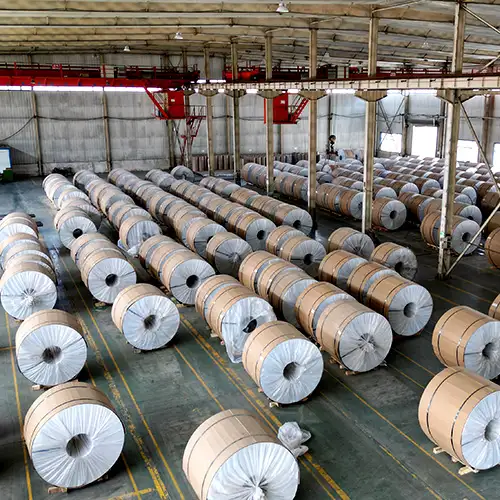
Aluminum coils are commonly used in building curtain walls, home appliance shells, automotive interiors and other fields. Their surface state is directly related to the durability and practicality of the product.
Aluminum coils are commonly used in building curtain walls, home appliance shells, automotive interiors and other fields. Their surface state is directly related to the durability and practicality of the product. Anodizing, as the mainstream surface treatment process for aluminum coils, is not an optional processing procedure, but a controllable electrochemical reaction that allows the performance of aluminum coils to be qualitatively improved.
In terms of corrosion resistance, an oxide film will naturally form on the surface of untreated aluminum coils, but this film is only 0.01-0.1 microns thick, with a loose and incomplete structure. It is easy to corrode in humid weather or slight acid and alkali erosion. Anodizing can form an artificial oxide film of 5-20 microns on the surface of aluminum coils. This dense film composed of aluminum oxide is like a solid barrier, which can increase the corrosion resistance of aluminum coils several times. In coastal humid areas or industrial environments with slight corrosion, anodized aluminum coils can remain intact for a long time, greatly reducing the probability of rust.
Improving surface hardness is an important role of anodizing. The surface hardness of raw aluminum is low, only about HV100, and it is easy to be scratched and worn during transportation, processing and use. The hardness of the oxide film formed by anodizing can reach HV300-500, which can effectively resist the friction and impact of external forces. This makes the aluminum coil less likely to be damaged during subsequent cutting, bending and other processing processes, and also extends the service life of the finished product. For example, after anodizing, the aluminum coil used for furniture panels will not cause obvious damage to its surface due to collisions and friction in daily use, and it can always maintain its beauty.
Anodizing also has advantages in combining decoration and functionality. The oxide film has porous characteristics and can absorb dyes, allowing the aluminum coil to present a rich variety of colors from basic silver to various customized colors to meet the appearance requirements of different scenes. Moreover, this coloring method is integrated with the oxide film, and it is not easy to fade and fall off like ordinary coatings. In addition, the porous structure of the oxide film can also be sealed, which can not only enhance the waterproof performance, but also give the surface anti-slip, insulation and other functions as needed.
From an economic point of view, although anodizing will increase some processing costs, it can save a lot of expenses in long-term use. The treated aluminum coil has better performance and can reduce the number of maintenance and replacements, especially in outdoor buildings, automotive exteriors and other scenes that require long-term use. The cost advantage brought by its durability is very obvious.
In general, the anodizing treatment of aluminum coils fundamentally solves the problems of poor corrosion resistance and insufficient hardness of original aluminum by improving the surface structure, while taking into account both decorative and functional properties. It is a key process to improve the competitiveness of aluminum coil products. Whether it is an industrial component that requires durability or a decorative material that focuses on beauty and texture, anodizing can provide reliable performance support for aluminum coils.
Related News
Shining 2025 China International Aluminum Industry Exhibition
From July 9 to 11, 2025, the highly anticipated 20th China International Aluminum Industry Exhibition will be held in Shanghai New International Expo Center.
The aluminum wire drawing process is a commonly used metal processing process in which aluminum is stretched and extruded to form the desired shape and size.
Aluminum plate types Aluminum plate usage guide
The 1 series aluminum plate model is the key raw material for manufacturing the bottom reflector of the heat pipe of solar water heater.
3 series aluminum plate material and model
The 1 series aluminum plate model is the key raw material for manufacturing the bottom reflector of the heat pipe of solar water heater.
1 series aluminum plate related knowledge
The 1 series aluminum plate model is the key raw material for manufacturing the bottom reflector of the heat pipe of solar water heater.
1mm aluminum plate The use of 1mm aluminum coil
1mm aluminum plate and 1mm aluminum coil have a wide range of applications in many fields because of their moderate thickness
Can't find the product you need?
Please contact us to provide you with satisfactory products and become a reliable supplier and service provider in the industry
Contact Us
Address: Gongyi City, Henan Province,China