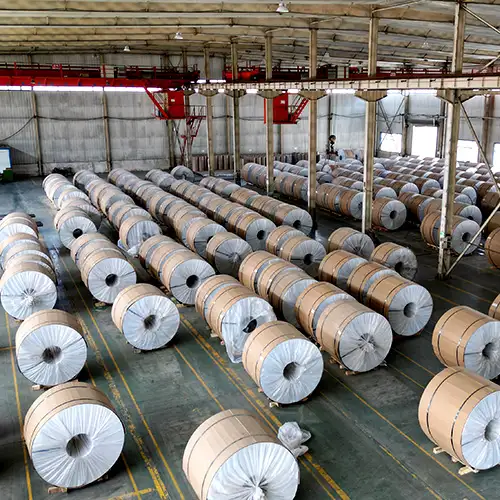
Aluminum Sheet: Its Transformation from Ore to Profile
Release time:
2025-08-06
Source:
In modern industry and construction, aluminum sheet, with its lightweight, corrosion-resistant, and easy-to-process properties, holds an irreplaceable position.
In modern industry and construction, aluminum sheet, with its lightweight, corrosion-resistant, and easy-to-process properties, holds an irreplaceable position. From high-rise curtain wall decoration to new energy vehicle body components, from household kitchenware to aerospace equipment, aluminum sheet is ubiquitous. Behind this seemingly ordinary metal sheet lies a sophisticated process that has been refined over centuries, each step embodying the wisdom of materials science and engineering.
The story of aluminum sheet begins with bauxite. As the source of aluminum, bauxite undergoes beneficiation and crushing to remove impurities and break it into uniform particles. This process then enters the dissolution process. Under high temperature and high pressure, the bauxite reacts with a sodium hydroxide solution to produce water-soluble sodium aluminate. Impurities such as iron and silicon are filtered out as a precipitate, a step that is essential for ensuring the purity of the aluminum.
The dissolved sodium aluminate solution is purified and then enters the electrolysis process. In the electrolytic cell, direct current passes through the molten cryolite-alumina system, causing aluminum ions to gain electrons at the cathode and transform into liquid aluminum. This process consumes a significant amount of electricity, leading to aluminum being called the "flying metal"—producing one ton of raw aluminum consumes approximately 13,000 kWh of electricity. This has also driven the aluminum industry to continuously explore the use of green energy.
The raw aluminum produced by electrolysis has a purity of approximately 99.5% and requires further purification to meet the needs of various applications. Using a three-layer liquid electrolysis process, the purity can be increased to over 99.99%. This high-purity aluminum better meets the stringent material performance requirements of precision electronics, aerospace, and other fields.
The purified aluminum ingots enter the rolling stage, the core step in forming aluminum sheets. Depending on the required thickness, the ingots are first rolled into thicker sheets in a hot rolling mill, followed by multiple passes through a cold rolling mill. During the cold rolling process, the grain size of the aluminum sheet is continuously refined, increasing its strength and toughness while also improving surface finish. It's worth noting that each rolling process requires annealing—heating to a specific temperature and then slowly cooling to eliminate internal stresses in the material and prevent cracking or deformation during subsequent processing.
Aluminum sheets requiring specialized properties also require heat treatment. For example, aluminum alloys for aviation use undergo solution treatment to evenly incorporate alloying elements into the aluminum matrix. Aging treatment then precipitates strengthening phases, doubling the sheet's strength. Aluminum sheets used in decorative applications undergo surface treatment: anodizing forms a dense oxide film, enhancing corrosion resistance and aesthetics; fluorocarbon spraying imparts rich colors and exceptional weather resistance.
From bauxite to finished aluminum sheet, over ten interlinked processes require not only the precision of the equipment but also the engineers' deep understanding of material properties. It's this continuously optimized process that has enabled aluminum sheet to achieve continuous breakthroughs in lightweighting, high strength, and multifunctionality, making it an indispensable "metal spirit" in modern industrial civilization.
Related News
Shining 2025 China International Aluminum Industry Exhibition
From July 9 to 11, 2025, the highly anticipated 20th China International Aluminum Industry Exhibition will be held in Shanghai New International Expo Center.
The aluminum wire drawing process is a commonly used metal processing process in which aluminum is stretched and extruded to form the desired shape and size.
Aluminum plate types Aluminum plate usage guide
The 1 series aluminum plate model is the key raw material for manufacturing the bottom reflector of the heat pipe of solar water heater.
3 series aluminum plate material and model
The 1 series aluminum plate model is the key raw material for manufacturing the bottom reflector of the heat pipe of solar water heater.
1 series aluminum plate related knowledge
The 1 series aluminum plate model is the key raw material for manufacturing the bottom reflector of the heat pipe of solar water heater.
1mm aluminum plate The use of 1mm aluminum coil
1mm aluminum plate and 1mm aluminum coil have a wide range of applications in many fields because of their moderate thickness
Can't find the product you need?
Please contact us to provide you with satisfactory products and become a reliable supplier and service provider in the industry
Contact Us
Address: Gongyi City, Henan Province,China