Aluminum Sheets and Coils Get a "New Look": Unlocking the Secrets of Surface Finishing
Release time:
2025-11-14
Source:
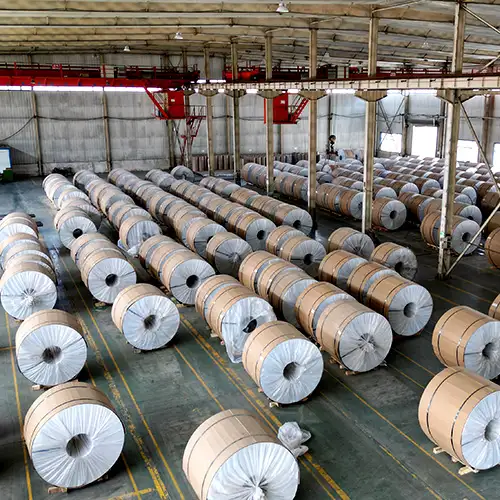
Aluminum sheets and coils are crucial in daily life and industrial production, widely used in construction, electronics, automotive, aerospace, and other fields. But have you ever wondered what would happen if aluminum sheets and coils weren't surface-finished?
Aluminum sheets and coils are crucial in daily life and industrial production, widely used in construction, electronics, automotive, aerospace, and other fields. But have you ever wondered what would happen if aluminum sheets and coils weren't surface-finished?
Unfinished aluminum sheets and coils present numerous problems. The natural oxide film is thin and fragile, easily corroded by humid air, acids, alkalis, and salts. For example, aluminum sheets in coastal buildings rust within a few years, and acids and alkalis in industrial environments can corrode aluminum sheets, causing equipment malfunctions. The rough and monotonous appearance fails to meet the aesthetic requirements of home and architectural decoration, limiting its application in high-end projects. Oil and impurities easily remain on the surface during processing, transportation, and use, affecting the appearance and subsequent processing. For instance, in electronic equipment manufacturing, aluminum sheets with oily surfaces used as casing materials will result in poor coating adhesion and unclear printing patterns.
Surface finishing can significantly enhance the corrosion resistance of aluminum sheets and coils and extend their service life. Common and effective methods include anodizing and coating treatments. During anodizing, the aluminum sheet and coil are placed as the anode in an electrolyte, generating a thin layer of aluminum oxide to block erosion and prevent corrosion. In terms of coating treatment, organic coatings resist atmospheric corrosion, inorganic coatings are suitable for harsh environments, and metallic coatings provide sacrificial anode protection. Experiments show that untreated aluminum plates exhibit obvious corrosion spots after 24 hours, anodized aluminum plates show slight corrosion after 168 hours, and aluminum plates coated with organic coatings remain intact after 336 hours. In the building curtain wall field, fluorocarbon-coated aluminum plates can withstand harsh outdoor environments for over 20 years without severe corrosion.
In today's pursuit of personalization and aesthetics, surface finishing allows aluminum plates and coils to achieve a double leap in both appearance and individuality, becoming an ideal choice for decoration in various fields.
The brushing process creates straight lines on the surface of aluminum plates and coils through mechanical friction or extrusion, which can remove scratches and enhance the decorative effect. Continuous brushed lines (long brushed lines) are smooth and are often used for the casings of home appliances such as refrigerators and washing machines; discontinuous brushed lines (short brushed lines, satin brushed lines) are delicate and soft, often used for the aluminum bodies of electronic products such as laptops, both enhancing the product's texture.
Color coating technology provides aluminum sheets and coils with a rich array of colors to meet diverse aesthetic needs. In building exterior decoration, such as office buildings and commercial complexes, color-coated aluminum sheets can blend with architectural styles to create unique visual effects. In automotive interiors, they are used for trim strips, center consoles, and other areas, adding personalized elements. Through special surface treatment technologies, aluminum sheets and coils can simulate realistic wood and stone grain effects. In interior decoration, wood-grain aluminum sheets are used to make furniture, combining the texture of wood with the durability of metal; stone-grain aluminum sheets are used for wall and floor decoration, creating a high-end and sophisticated effect, and are commonly used in hotel and villa decoration.
These surface-processed aluminum sheets and coils can create diverse living spaces in home decoration, satisfying homeowners' pursuit of individuality and aesthetics; in architectural decoration, they can create unique building appearances, enhancing the artistic value and recognizability of buildings.
Surface processing can also significantly optimize the physical properties of aluminum sheets and coils, greatly expanding their application range.
Taking hardness enhancement as an example, hard anodizing significantly increases the hardness of the oxide film formed on the surface of aluminum sheets and coils, reaching 250-500 HV, far exceeding the hardness of untreated aluminum sheets. This high hardness makes aluminum sheets and coils suitable for applications requiring high material hardness. In the machinery manufacturing industry, hard-anodized aluminum sheets can be used to manufacture mechanical parts, such as engine pistons and cylinders, effectively resisting wear and impact, and improving the service life and working efficiency of the parts. In automobile manufacturing, high-hardness aluminum sheets can be used to manufacture wheel hubs, brake discs, and other components, not only reducing the weight of the vehicle but also improving the wear resistance and safety of the parts.
Surface processing can also effectively improve the wear resistance of aluminum sheets and coils.
In the electronic equipment manufacturing industry, insulation is one of the important performance indicators of aluminum sheets and coils. Through surface treatments such as anodizing and organic coatings, an insulating film can be formed on the surface of aluminum sheets and coils, effectively improving their insulation performance. In circuit board manufacturing, using anodized aluminum sheets as substrates ensures stable electrical performance of the circuit boards and prevents problems such as short circuits. In the manufacture of enclosures for some electrical equipment, aluminum sheets with good insulation properties can improve equipment safety and protect users from the risk of electric shock.
Surface finishing of aluminum sheets and coils is crucial for enhancing their overall performance and application value. In terms of protection, treatments such as oxidation and coating allow aluminum sheets and coils to maintain chemical stability and corrosion resistance in complex environments, extending their service life and ensuring long-term application in fields such as construction. Aesthetically, processes like wire drawing offer diverse appearances to meet the aesthetic needs of different industries. In terms of performance optimization, surface finishing can improve physical properties and expand the range of applications. With technological advancements and changing market demands, aluminum sheet and coil surface finishing technology is facing new opportunities and challenges, and its future development will move towards greater environmental friendliness, higher performance, and greater diversification.
Preceding Page
Related News
Shining 2025 China International Aluminum Industry Exhibition
From July 9 to 11, 2025, the highly anticipated 20th China International Aluminum Industry Exhibition will be held in Shanghai New International Expo Center.
The aluminum wire drawing process is a commonly used metal processing process in which aluminum is stretched and extruded to form the desired shape and size.
Aluminum plate types Aluminum plate usage guide
The 1 series aluminum plate model is the key raw material for manufacturing the bottom reflector of the heat pipe of solar water heater.
3 series aluminum plate material and model
The 1 series aluminum plate model is the key raw material for manufacturing the bottom reflector of the heat pipe of solar water heater.
1 series aluminum plate related knowledge
The 1 series aluminum plate model is the key raw material for manufacturing the bottom reflector of the heat pipe of solar water heater.
1mm aluminum plate The use of 1mm aluminum coil
1mm aluminum plate and 1mm aluminum coil have a wide range of applications in many fields because of their moderate thickness
Can't find the product you need?
Please contact us to provide you with satisfactory products and become a reliable supplier and service provider in the industry
Contact Us
Address: Gongyi City, Henan Province,China